
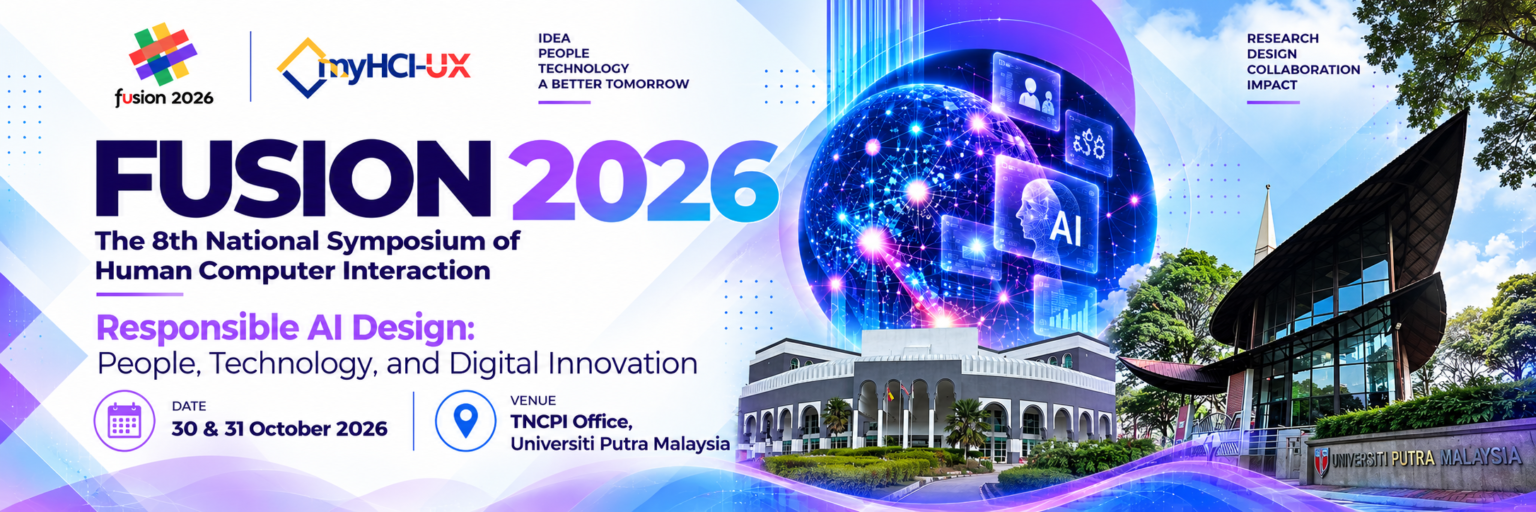
Welcome to FUSION 2026
Connecting People, Research, Design and Technology
The Kuala Lumpur ACM SIGCHI Chapter proudly presents the 8th National Symposium of Human Computer Interaction, themed “Responsible AI Design: People, Technology, and Digital Innovation”.
The symposium provides a collaborative platform for academics, researchers, industry practitioners, postgraduate students and undergraduate students to exchange ideas, showcase innovative work and discuss emerging developments in Human-Computer Interaction (HCI), User Experience (UX), Artificial Intelligence and Digital Innovation.
This year’s symposium places special emphasis on designing technology responsibly while ensuring that innovation remains centred on people, society and meaningful human experiences.
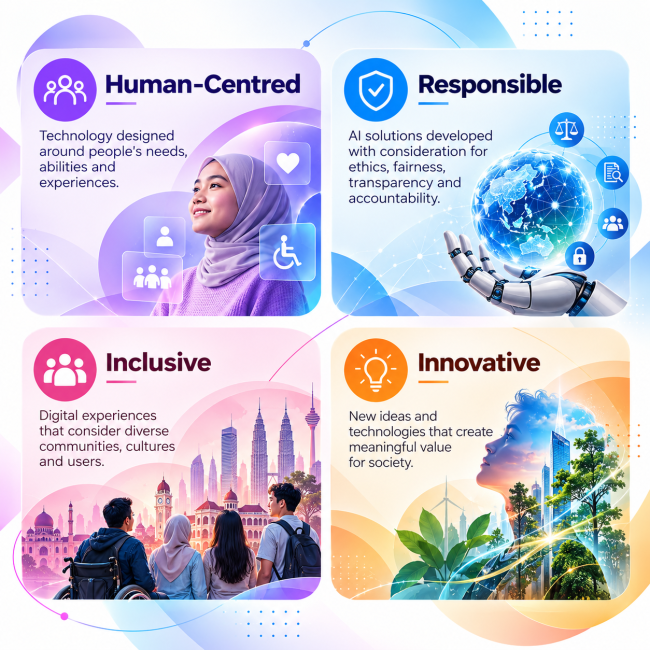
Responsible AI Design: People, Technology, and Digital Innovation
Artificial Intelligence is becoming an increasingly important part of how people learn, work, communicate and interact with technology.
FUSION 2026 explores how AI-enabled systems and digital experiences can be designed in ways that are:
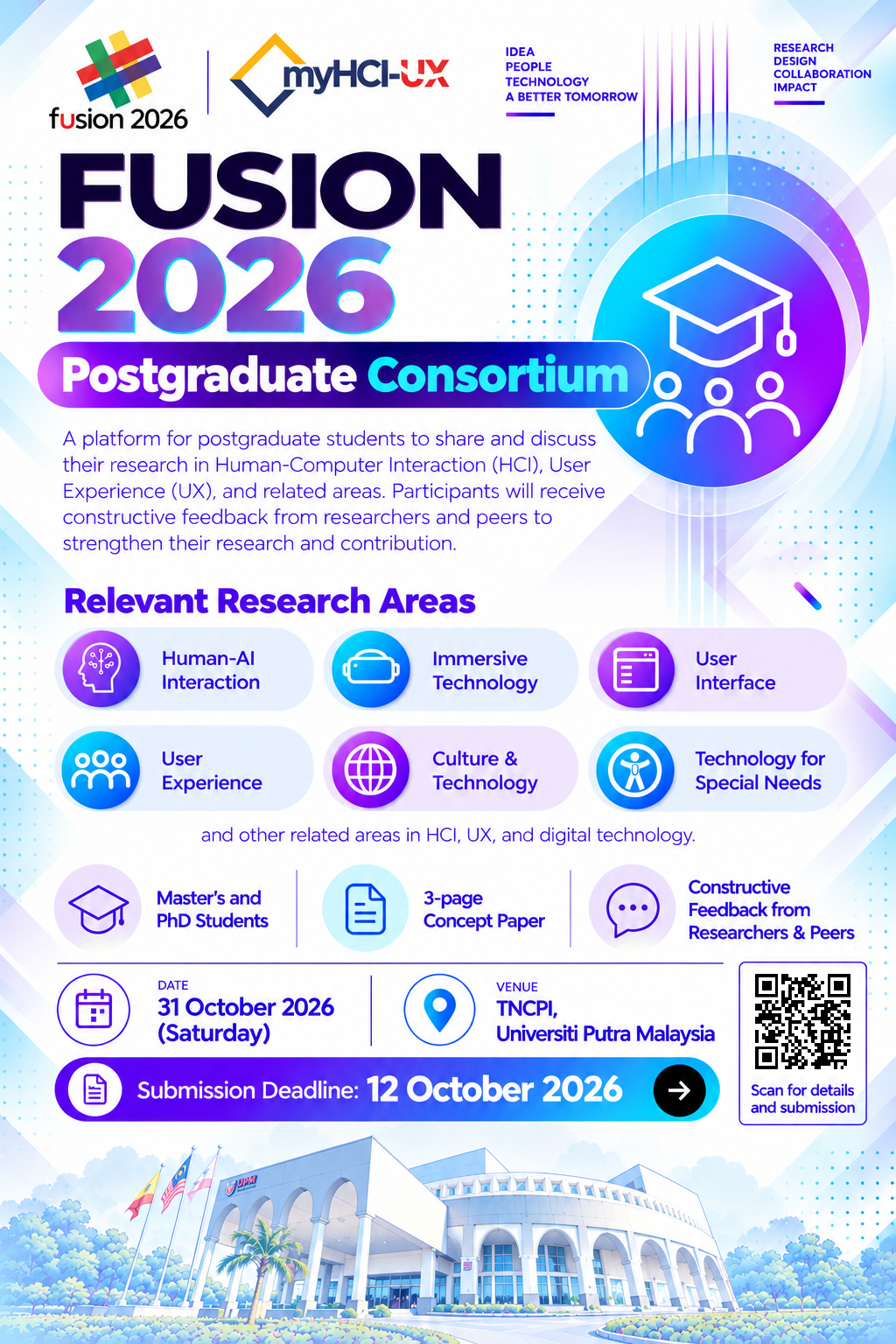
Postgraduate Consortium (PC)
A platform for researchers to present their work, exchange ideas and receive constructive feedback from academics and members of the HCI community.
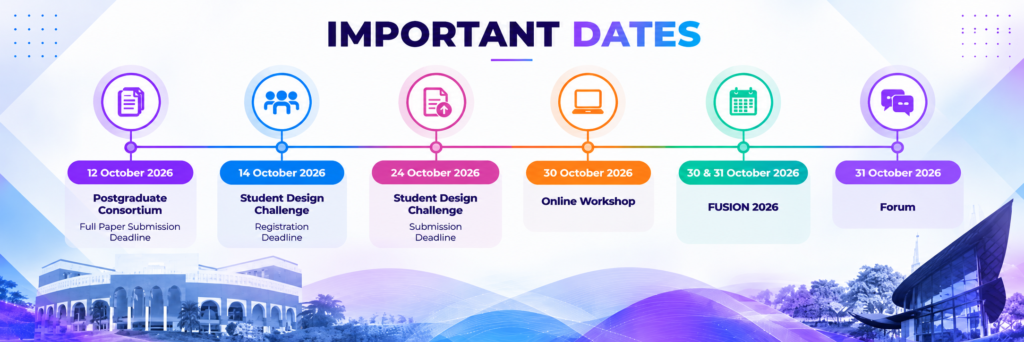
Full Paper Submission Deadline:
12 October 2026
Register now: https://forms.gle/BsiPcz6VDhdtLutm9
Student Design Challenge (SDC)
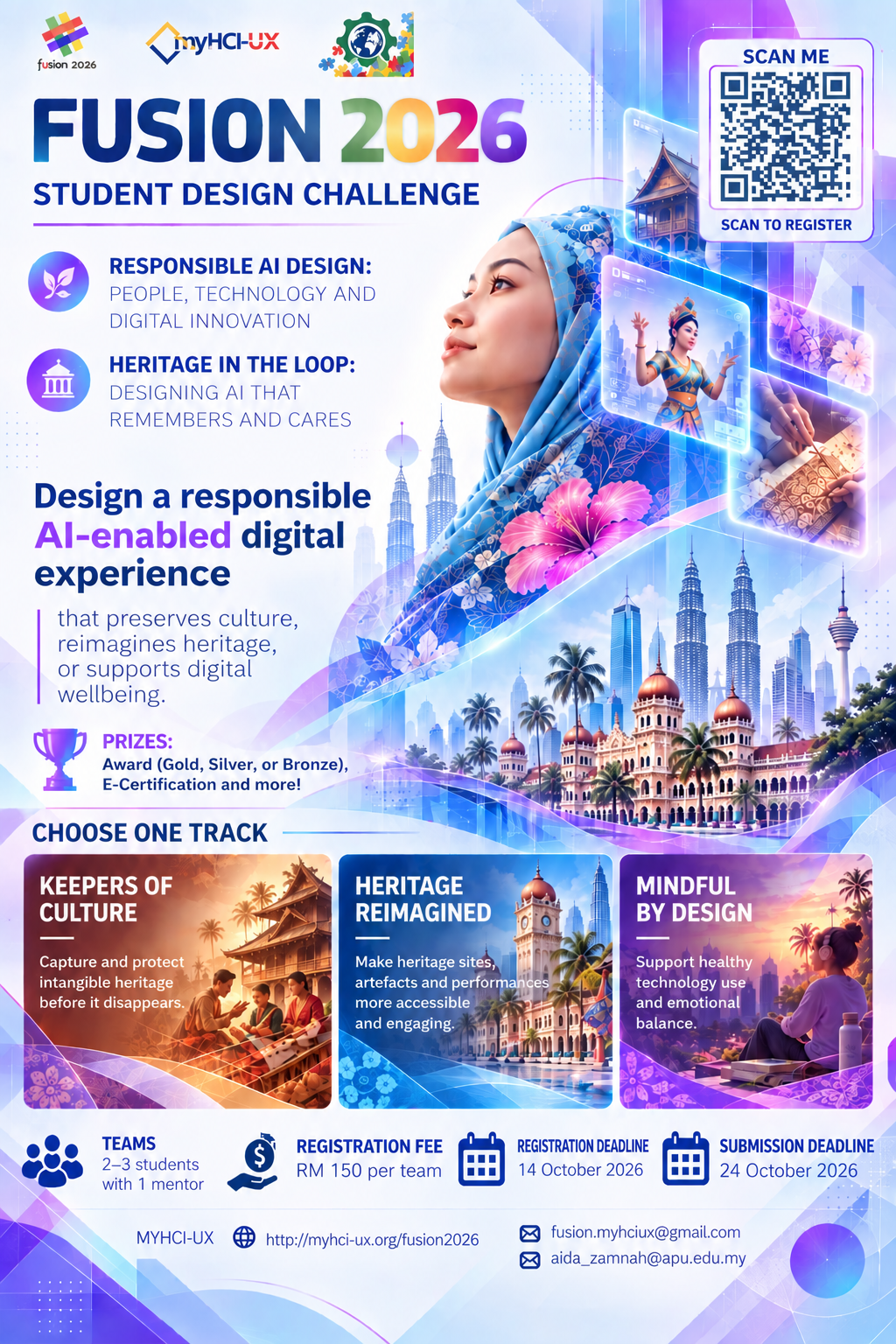
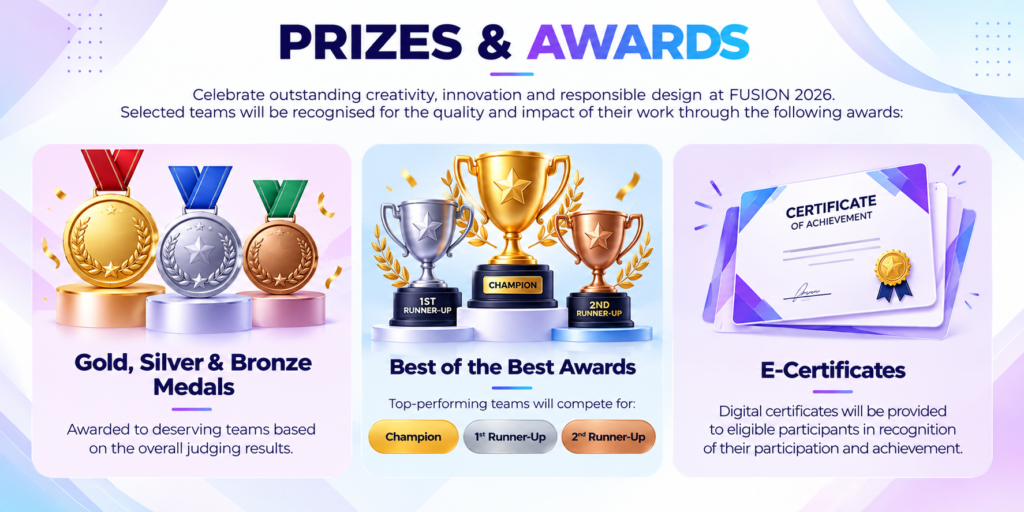
An opportunity for students to demonstrate their creativity and problem-solving skills by designing responsible AI-enabled digital experiences.
Participants will explore themes related to culture, heritage and digital wellbeing.
Registration Deadline:
14 October 2026
Submission Deadline:
24 October 2026
Register now:
Online Workshop
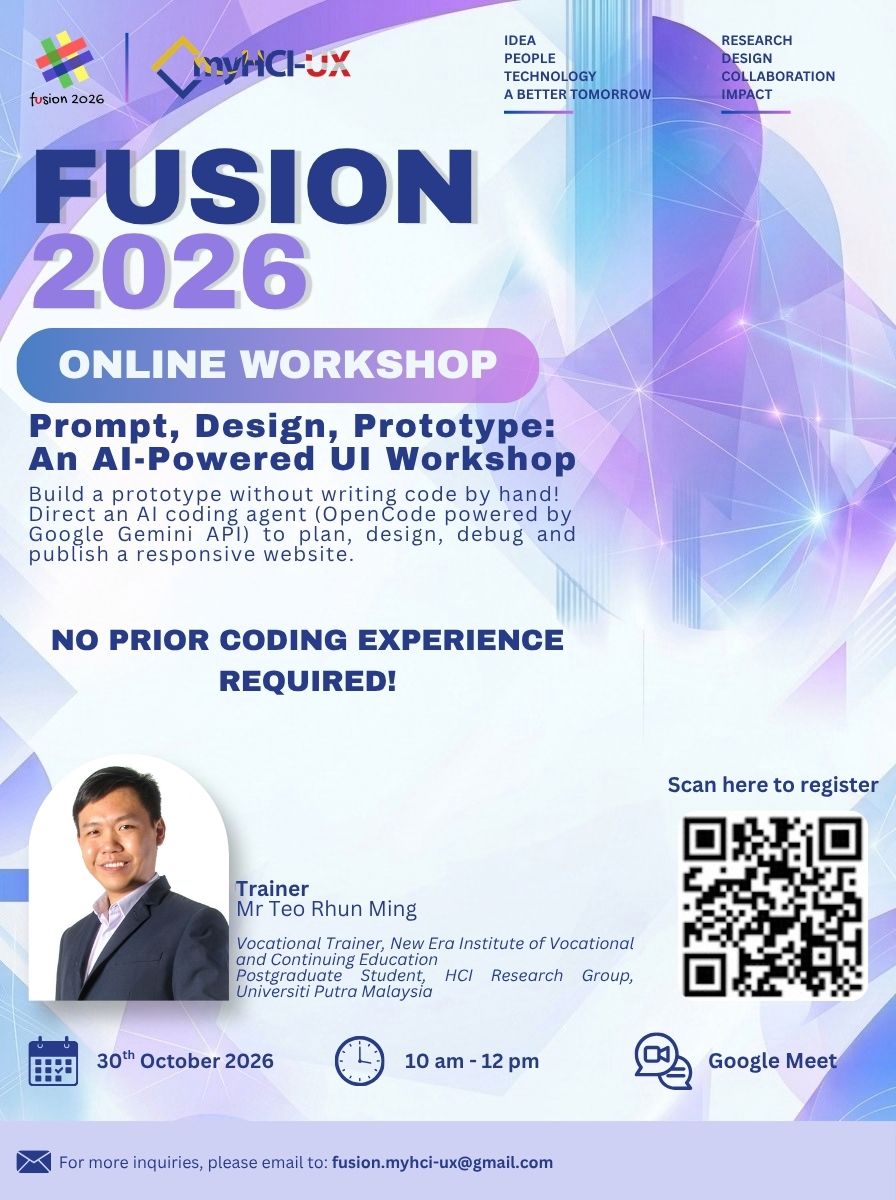
Prompt, Design, Prototype: An AI-Powered UI Workshop
Discover how AI can support the UI design and prototyping process.
Participants will learn how to use an AI coding agent to plan, design, debug and publish a responsive digital prototype.
No prior coding experience required.
📅 30 October 2026
🕙 10:00 AM – 12:00 PM
💻 Online via Google Meet
Register now: https://forms.gle/BsiPcz6VDhdtLutm9
Forum
Join academics, researchers and practitioners for conversations around the opportunities, responsibilities and future directions of AI, HCI and digital innovation.
📅 31 October 2026
The forum encourages knowledge sharing and discussion on how responsible technology can create positive impact for individuals, organisations and society.
Register now: https://forms.gle/BsiPcz6VDhdtLutm9
Why Join FUSION 2026?
Discover
Explore emerging ideas, research and developments in HCI, UX, AI and digital innovation.
Connect
Meet researchers, academics, students, designers and industry practitioners from the HCI and technology community.
Create
Turn ideas into meaningful digital experiences through workshops, research discussions and design challenges.
Collaborate
Build new academic, research and industry connections.
Make an Impact
Explore how responsible design and technology can contribute to a more inclusive and sustainable digital future.
Register now: https://forms.gle/BsiPcz6VDhdtLutm9
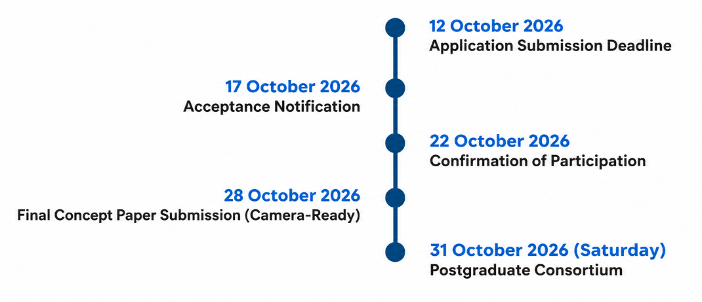
Important Dates
In Progress
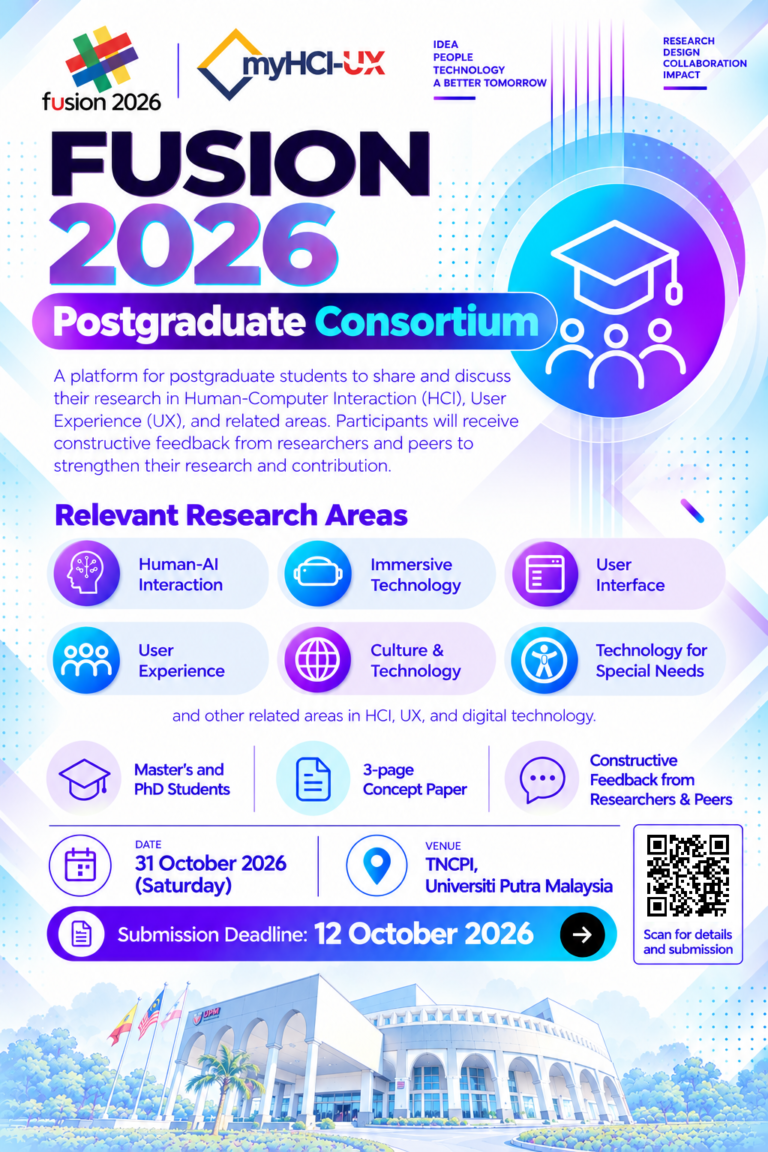
The Postgraduate Consortium (PC) at FUSION2026 provides a platform for postgraduate students working in Human-Computer Interaction (HCI), User Experience (UX), and related areas to present and discuss their ongoing research. The consortium gives participants an opportunity to share their research problems, objectives, methods, preliminary findings, and research challenges with peers and experienced researchers. Participants will receive constructive feedback that may help them refine their research and strengthen its contribution. The PC also encourages interaction and knowledge sharing among postgraduate students, researchers, and the wider HCI community. The consortium welcomes postgraduate students conducting research in HCI, UX, and related areas, including Master’s and PhD students.
Relevant research areas may include, but are not limited to:
- Human–AI Interaction
- Immersive Technology
- User Interface
- User Experience
- Culture and Technology
- Technology for Special Needs
- Other related areas in HCI, UX, and digital technology
For further enquiries, please contact: azrina@upm.edu.my
Concept Paper
Applicants are required to submit a concept paper in PDF format, with a maximum length of three (3) pages (including references), using the provided FUSION2026 Postgraduate Consortium template.
The concept paper should include:
- Title of the research
- Student’s name, university/affiliation, and email address
- Name and email address of the research advisor/supervisor
- Abstract – maximum 250 words
- Introduction – a brief description of the research topic, including:
- Problem Statement – the research problem being addressed, its importance, and the gap in existing research
- Research Objectives
- Research Methods – methods used or proposed for conducting the research, including how the research will be evaluated
- Results or Expected Results – preliminary findings, where available, or expected research outcomes
- Discussion – proposed solution or approach and the expected contribution of the research
- Conclusion
- Work to Date and Issues for Discussion – a short description of the research completed so far and specific questions, challenges, or issues that the student would like to discuss during the consortium
Submission Guidelines
The concept paper should be submitted in PDF format, with a maximum length of three (3) pages including references, using the provided FUSION2026 Postgraduate Consortium Template: https://bit.ly/3VjLyrZ
Applications must be submitted through the FUSION2026 Postgraduate Consortium Google Form: https://forms.gle/eik6J9SF4n2Zu63K8
Note: Submission to the Postgraduate Consortium is separate from the main FUSION2026 registration.
Participation and Registration
Accepted concept papers will be invited to participate in the FUSION2026 Postgraduate Consortium. The presenting student is required to present the accepted work during the consortium session and complete the applicable FUSION2026 registration payment.
Background
AI can now translate dying dialects, restore damaged artefacts and guide visitors through heritage sites. It can also get cultural facts wrong, take community knowledge without permission, and keep people glued to screens longer than is good for them.
What this really means is that the same technology can protect culture or erode it, support wellbeing, or wear it down. The difference comes down to design decisions, and that is what this challenge is about.
The Challenge
Design a digital experience that preserves culture, makes heritage accessible, or supports digital wellbeing, while keeping people and communities in control. AI should play a meaningful role, but your design decisions are what we are judging. Your solution doesn’t need to be a working AI system. It needs to be a well-researched, clearly designed concept that shows your design process, how AI supports the experience, and why your design choices are responsible. AI doesn’t have to be the centrepiece. A strong entry might use AI in one well-chosen feature, or even argue why AI should be kept out of part of the experience. That is responsible design too.
Objectives
By completing this challenge, participants will:
- Apply a user centred design process to a real cultural or wellbeing problem.
- Explore and refine ideas through sketching and feedback.
- Explore how AI can add value without replacing human judgement.
- Identify ethical risks early and design safeguards into the solution.
- Communicate a design concept visually and through storytelling.
Team Requirements
- Teams of 2 to 3 students, with 1 mentor
- The mentor guides the team on direction, research, and feedback, but the design work must be done by the students.
- Open to Undergraduate & Postgraduate students.
- Each team submits one entry under one track only.
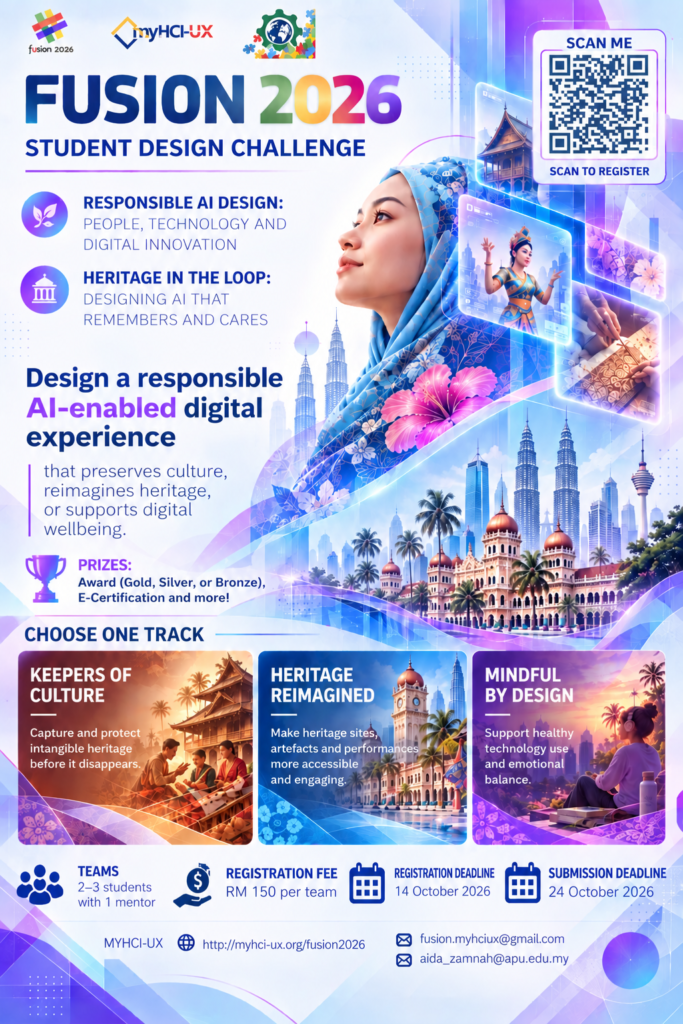
For further enquiries, please contact: aida_zamnah@apu.edu.my
Participants to choose one track
Track A: Keepers of Culture
- Design experiences that capture and protect intangible heritage before it disappears.
- Ideas to explore: endangered dialects, traditional crafts, heirloom recipes, folk games, oral histories from elders.
- Key design question: Who owns the cultural knowledge, and how does your design keep the community in control of it?
Track B: Heritage Reimagined
- Design experiences that make heritage sites, artefacts, and performances more accessible and engaging.
- Ideas to explore: AR at heritage buildings, interactive museum guides, digital archives, digital revival of traditional performing arts.
- Key design question: How does your design stop technology from inventing, simplifying, or distorting cultural facts?
Track C: Mindful by Design
- Design experiences that support healthy technology use and emotional balance.
- Ideas to explore: screen fatigue, study burnout, loneliness, digital detox, local wellbeing practices such as gotong royong or kampung community life.
- Key design question: Where does helpful engagement cross the line into manipulation, and how does your design stay on the right side?
Rules
- All work must be original.
- Using generative AI tools (images, text, voice, video) is allowed, but every use must be declared in the AI use disclosure on the canvas. Responsible use is marked. Undeclared use may lead to disqualification.
- Cultural content must be represented respectfully and accurately. Cite sources for cultural facts.
- Get consent from anyone filmed, interviewed, or asked for feedback.
- Late submissions will not be accepted.
SDG Alignment
Teams must link their concept to at least one:
- SDG 3: Good Health and Wellbeing
- SDG 4: Quality Education
- SDG 9: Industry, Innovation, and Infrastructure
- SDG 11.4: Protect and safeguard cultural and natural heritage.
Deliverables
1. Concept Poster
- Size: A2, portrait
- Format: PDF, minimum 300 dpi
- Must include: problem statement, user research findings, a persona, a user journey, key screens, how AI supports the experience, a Responsibility by Design section, chosen track and SDG alignment.
- Must show how the idea developed: early sketches or alternative ideas, and any feedback gathered from users, peers, or the mentor.
2. Concept Video
- Length: 2 to 3 minutes (entries over 3 minutes will be penalised)
- Format: MP4, 1080p
- Must include: the problem told through a user scenario, a walkthrough of the solution, mockups, or a clickable prototype, and one responsible design decision the team made.
- Use only royalty free music and assets.
3. Responsible Design Canvas
- One page, using the provided template.
- Covers whose culture or data is involved, potential risks, and how the design prevents harm.
- Includes an AI use disclosure: which AI tools the team used, for what, and how the output was checked. If no AI tools were used, state that.
Tip: the poster and video can share the same mockups, so design your screens once and reuse them.
Submission Guidelines
Submit all three files to [platform / link] using this naming format:
FUSION2026_[Track]_[TeamName]_[Poster/Video/Canvas] – to be updated
Judging Criteria
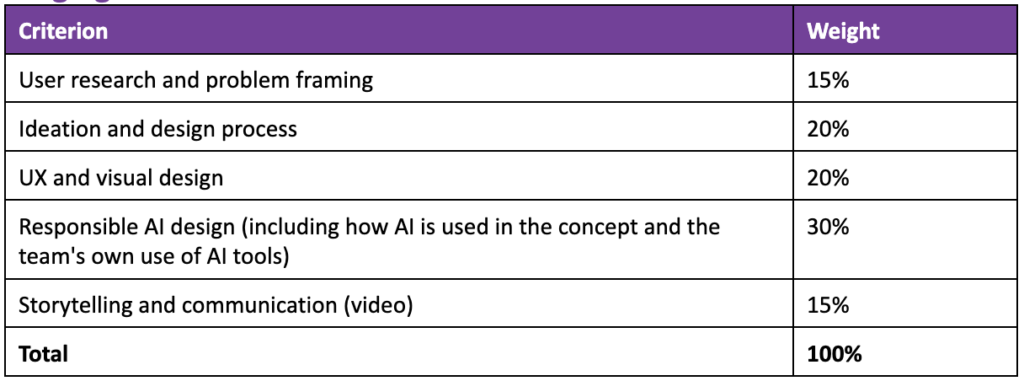
Responsible AI design carries the most weight because it is the heart of this year’s theme. Judges look at how AI is used in your concept and how responsibly your team used AI tools to create the entry. The other 70% rewards the design itself.
Bonus: teams that validate their concept with target users will be credited under Ideation and design process. This is encouraged, not required.
Marking guide: detailed descriptors for every criterion, including the six Responsible AI sub criteria, are in the FUSION 2026 Marking Guide.
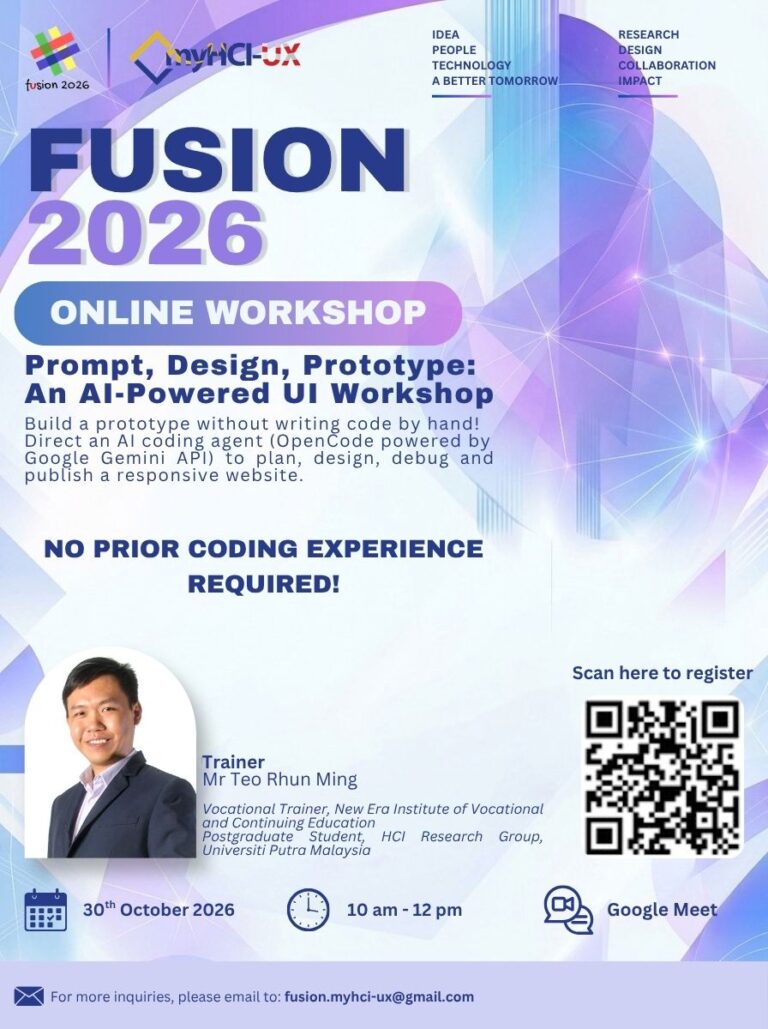
Prompt, Design, Prototype: An AI-Powered UI Workshop
Build a working website prototype with AI — without writing code by hand.
Discover how AI coding agents can support the complete UI development process, from planning an idea to building, debugging, and refining a responsive website.
In this hands-on workshop, participants will work with OpenCode powered by the Google Gemini API and learn how to guide an AI coding agent through structured prompts rather than manually writing every line of code. The session is designed as an end-to-end experience, taking participants through the plan → build → debug workflow.
No prior coding experience is required.
What Will You Learn?
By the end of the workshop, participants will be introduced to how to:
Set Up an AI Coding Environment
Connect OpenCode with a personal Google Gemini API key and work within a prepared development environment.
Plan with Prompts
Translate a project brief into structured prompts for the sitemap, content structure, and visual direction.
Develop a Responsive UI
Generate interface pages and components through iterative prompting.
Debug with AI
Identify layout or runtime problems and use AI prompts to help diagnose and resolve them.
Evaluate AI Output
Review AI-generated results critically and refine them towards a usable prototype.
Practise Responsible AI Use
Add a visible AI-use disclosure to the completed website to encourage transparency and responsible practice.
Register for the Workshop
Ready to Prompt, Design and Prototype?
Date: 30 October 2026
Time: 10:00 AM – 12:00 PM
Venue: Online via Google Meet
Register now: https://forms.gle/BsiPcz6VDhdtLutm9
For further enquiries, please contact: fusion.myhciux@gmail.com
In Progress
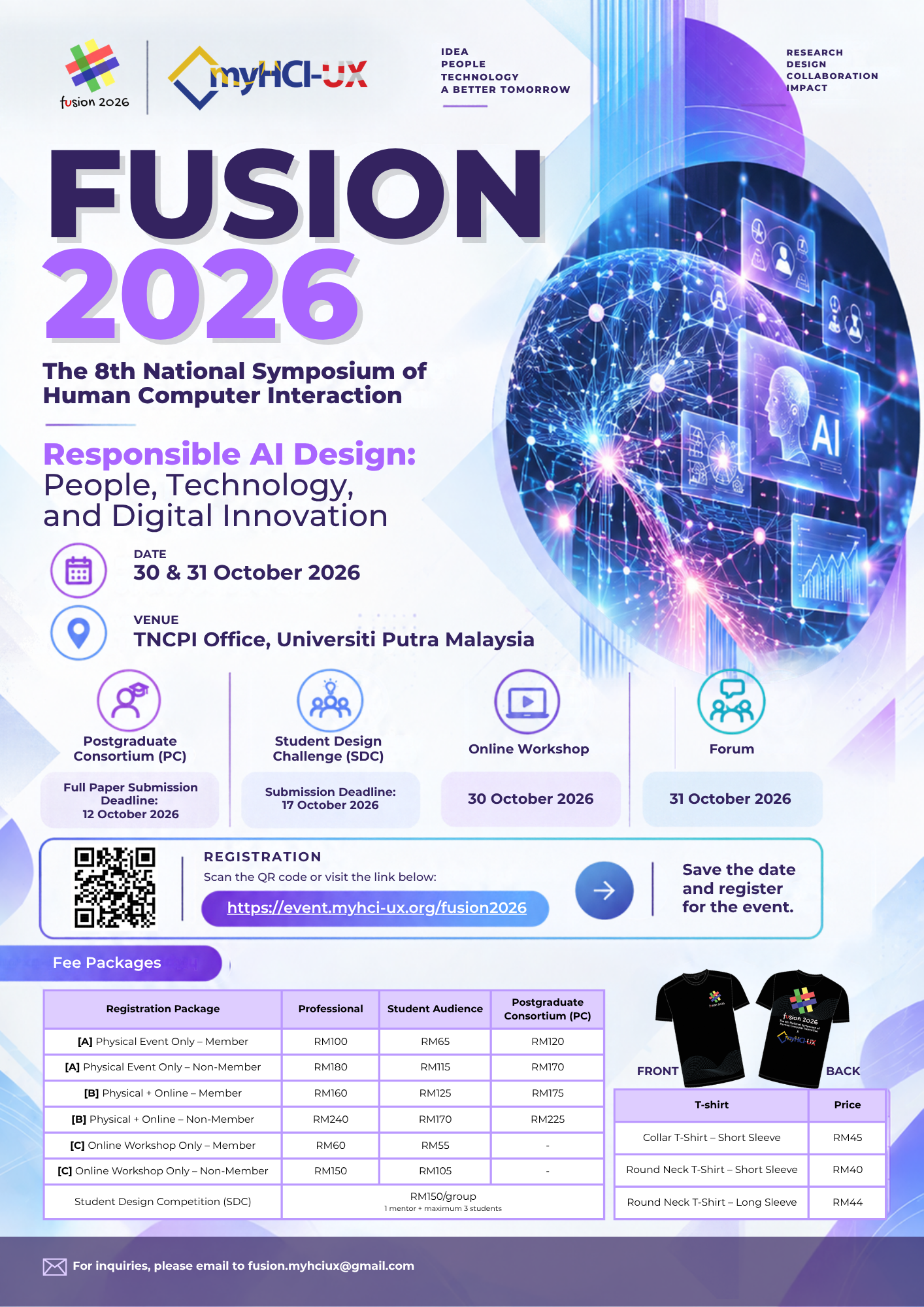
Fee Packages
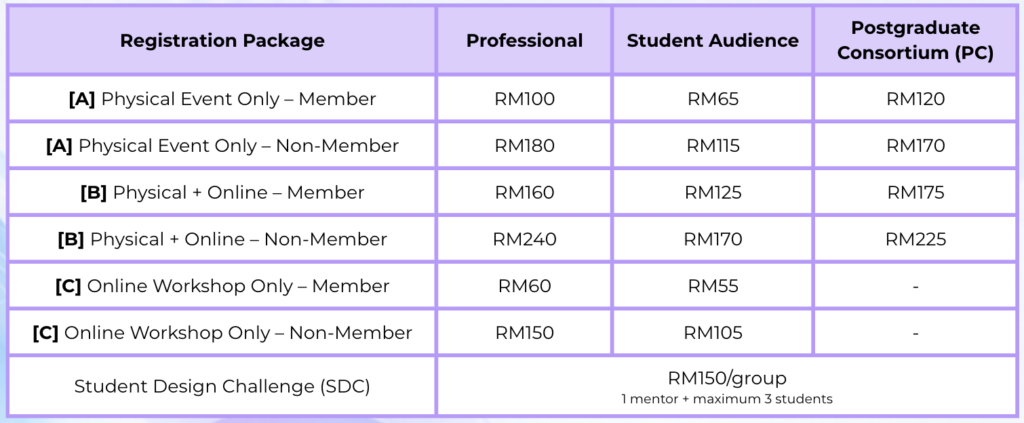
Registration
FUSION 2026 & Postgraduate Consortium (PC): https://forms.gle/BsiPcz6VDhdtLutm9

Student Design Challenge:
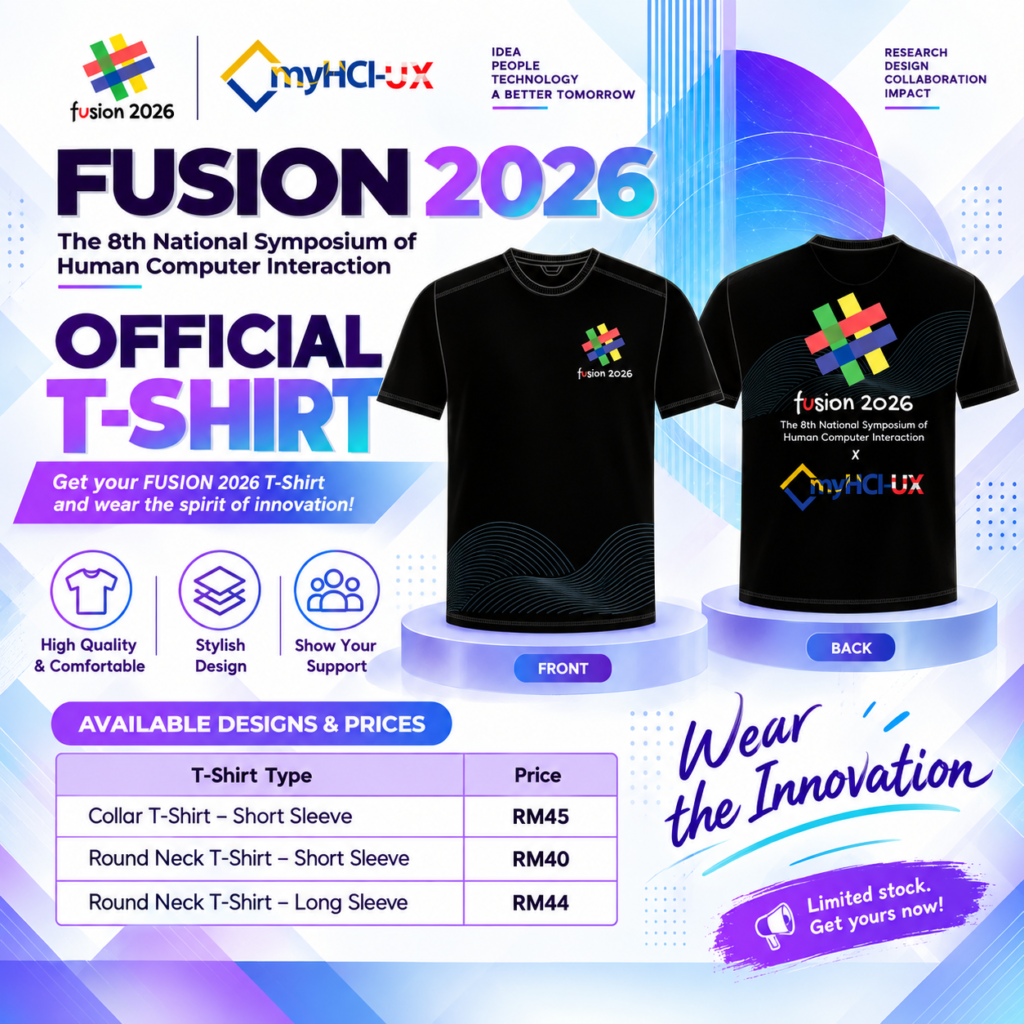
Official FUSION 2026 T-Shirt
Wear the Innovation
Celebrate FUSION 2026—The 8th National Symposium of Human Computer Interaction with the official event T-shirt.
Designed specially for FUSION 2026, the T-shirt combines the event identity with a clean, contemporary design inspired by people, technology, innovation, and human-computer interaction.
Wear it during the symposium and show your support for the FUSION 2026 community.
For further enquiries, please contact: fusion.myhciux@gmail.com
In Progress
Contact us:
FUSION 2026: fusion.myhciux@gmail.com
Postgraduate Consortium (PC): azrina@upm.edu.my
Student Design Challenge (SDC): aida_zamnah@apu.edu.my